60 Minutes Story About Illegal Immigrant Families Being Separated at the Border
It's been 35 years since Congress concluding passed a sweeping overhaul of the immigration organisation. And so, president after president has careened from crisis to crisis at the border. President Biden is no dissimilar.
His administration is struggling to deal with one of the largest surges of migrants at the southern border in 20 years while, at the same fourth dimension, trying to clean up another immigration mess yous might think was already fixed.
Remember the stories of migrant children beingness intentionally separated from their parents at the border in 2018? The practice sparked widespread, bipartisan outrage and forced President Trump to social club an terminate to the separations. Soon after, a federal judge ordered the government to reunite the families.
Only iii years later, at least a g children have not been returned to their parents.
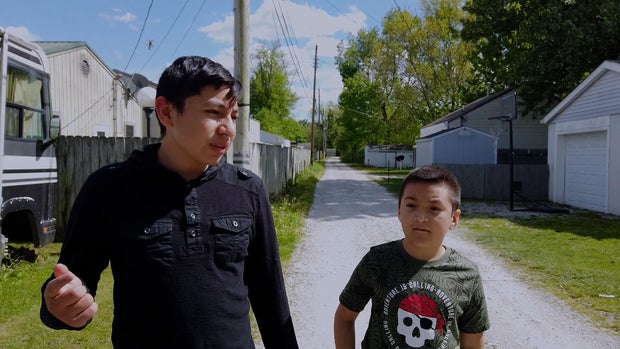
We went to southern Indiana to come across two of those children from El Salvador. Jaime is 13. His brother Adonis is 9. In 2017, the boys and their mother crossed this span that links Mexico to the Usa. The boys don't remember much about the trip, just Jaime has a bright retention of when U.S. border officers took his female parent away.
Sharyn Alfonsi: When they took your mom away, do you think what she said to you?
Jaime: Yes, she told me to be a potent brother, to help my brother and everything, to never feel bad… don't worry most what happened, worry about your brother.
Jaime and Adonis were among the first of nearly iv,000 children to be intentionally separated from their parents at the border equally part of the Trump administration's zero-tolerance immigration policy. A federal guess ordered the government to reunite the families inside xxx days. That was in 2018.
- DHS Sec. Mayorkas calls for legislation to grant separated families legal status
Sharyn Alfonsi: I think a lot of people will say to themselves, similar, "How can they non have reunited these families already? There's parents and there's a kid, and you lot've gotta get them together." Why is information technology so difficult?
Michelle Brane: It'southward been three-plus years for a lot of these families. They have moved to unlike places. Then they're no longer at the addresses we may have last had for them. They-- in many cases, these children are with sponsors who they now call mommy and daddy, right? Then information technology's not equally elementary as only saying, "Gonna put you on a aeroplane, and reunify you, and so we're done."
Michelle Brane leads the family reunification task force formed past President Biden in the first weeks of his presidency. Iv federal agencies are working on information technology, only despite their power and reach, in 7 months, they've merely reunited 52 families.
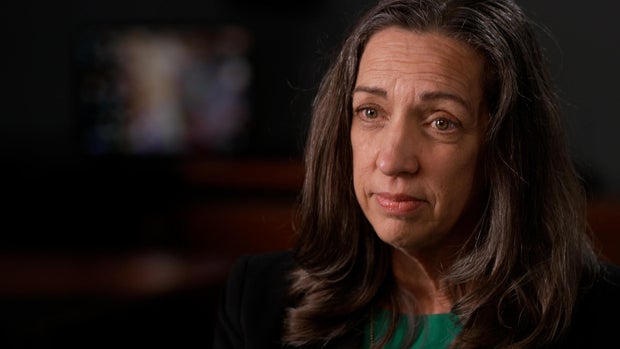
Michelle Brane: We approximate that over 1,000, somewhere between ane,000, 1,500 maybe more than remain separated. It's very hard to know because there'due south no record.
Sharyn Alfonsi: How practise you separate a child from their parents, and there's no documentation?
Michelle Brane: It is shocking. And actually, what happened was that there was no organization in place for documenting separations. So there's nowhere to go to find out who was separated or not. It actually is case-past-case detective work.
A federal investigation described the government'due south record-keeping during child separations as "ad-hoc." One border station "used a bones whiteboard" to keep track of the children. Phone numbers, addresses and names for parents were missing. The federal judge who ordered the U.S. authorities in 2018 to reunite the families wrote, "migrant children are not accounted for with the same efficiency and accurateness as property."
Lee Gelernt: When I began investigating this did I think that, in 2021, I'd be sitting here in El Salvador, withal looking for families, not in a meg years. Looking dorsum, maybe I was naïve.
Lee Gelernt is a lawyer with the American Ceremonious Liberties Union. Nosotros met him in Primal America. Gelernt led the lawsuit to finish the practice of family separation.
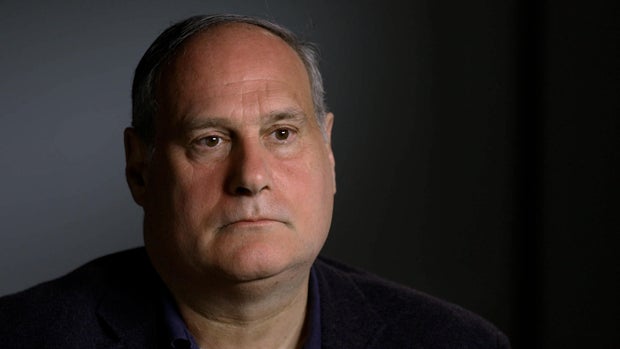
For two years, he's been working with local teams to assistance detect the parents that were separated from their children and so deported.
Lee Gelernt: When we got the showtime list of children and there were children nether a year old, vi months old, hundreds-- we were shocked. I mean, really shocked.
Sharyn Alfonsi: I call back a lot of people might recall, "If someone took my child and I was in El Salvador, I-- I'd be at the U.S. Embassy banging on the door to get my kid back." Why aren't they banging on the doors of the embassy, saying, "I desire my child dorsum?"
Lee Gelernt: One mother said to me, "I got upwards the backbone to enquire, 'Where are y'all taking my child?' And they said, 'Chicago.'" And she said, "I had no idea if that was a person, a place, a government agency. Simply I was too scared to ask a follow-upwardly question."
One of the parents his search squad plant in El Salvador was this woman. Her name is Sulma and she is the mother of those ii boys we met in Indiana.
The stories of separated families are rarely uncomplicated and neither is theirs. Sulma told united states of america she first sought asylum in the U.South. in 2014 with her two daughters because they were threatened by a gang leader. But a year later, she returned to El Salvador because she says her estranged husband failed to care for her two boys and the gangs were now targeting them. Sulma decided to flee to the U.S. again, this fourth dimension with Adonis and Jaime - who were 5 and ix years sometime.
Sharyn Alfonsi: Then, what happened when you presented yourself to the border agents?
Sulma (Translation): When I got across with the kids, they saw my file and they said I was trafficking people and those children were not mine. That the nativity certificates that I showed were not originals and that I had made them up.
Sharyn Alfonsi: How long afterward you crossed the edge were y'all separated from your sons?
Sulma (Translation): I spent mayhap 4 hours with them.
Sharyn Alfonsi: Did you get to say bye?
Sulma (Translation): Yeah, a little because it was close to midnight, so they were comatose when they came in to say they were taking them away.
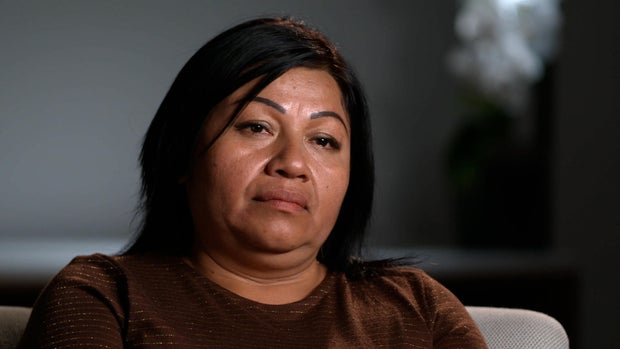
A study filed by U.S. Customs and Border Protection supports her story. Information technology says the family unit crossed legally at the bridge and Sulma told officers she was agape to return to her country and requested aviary. But U.Southward. border officers took her boys from her. What Sulma had no way of knowing is that the Trump administration had already started quietly separating children from their parents at the border. The practice wouldn't become public for some other five months.
Sharyn Alfonsi: When they said they were going to carry you lot, did you say, "I want my kids to come dorsum with me"?
Sulma (Translation): Yes, with me. Aye, I told them and they said no and that I couldn't do anything because I had brought them and turned them into immigration.
Sulma says an clearing judge warned her if she tried to cross the border again, she'd be banned from the United States for life.
She was deported back to Republic of el salvador on one of the jets chartered by U.Southward. Clearing and Customs Enforcement. Each flight costs U.S. taxpayers nigh $64,000.
Sharyn Alfonsi: When y'all await back on it, do you regret trying to cross the border with your boys?
Sulma (Translation): Yeah, my whole life, yeah all the style. That's what hurts the most, what I comport the longest in my heart, that deep regret. If I could go back, I never would have left.
Jaime and Adonis were sent to New York where they spent five months in a group abode before they were ultimately sent to Indiana to live with their sis, Katherine.
She was one of the daughters Sulma brought to the U.S. seven years ago and is nevertheless waiting for her own aviary claim to be resolved.
Fifty-fifty though Sulma and her sons spoke constantly by telephone, they somehow were lost in the arrangement. Because of that shoddy regime record-keeping within U.S. Immigration, their names didn't appear on any of the lists given to search teams. And so for 2 years, they were separated and no 1 was trying to get them back together. When their file was finally discovered, information technology was incomplete. There was no phone number or address for Sulma or her boys in Indiana. It took the ACLU and the team in El salvador three months to runway her down through relatives and friends.
This summertime, the U.S. regime brought the parents of 42 of the children into the country to be reunited. Sulma was 1 of them. She whispered a prayer of thanks as she made her fashion to the arrivals area at the Indianapolis airport and into the arms of her sons, for the first time in three and a half years.
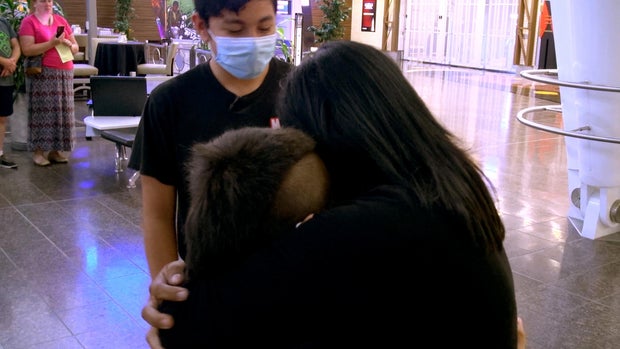
It was also the offset time she'd been with her oldest daughter in 6 years. The first time she held her granddaughter. And the first time she could thank Jaime in person for taking care of his little brother. Nosotros heard her say again and again, "I'one thousand lamentable."
Sharyn Alfonsi: When yous got off the plane, you apologized to the kids.
Sulma: Yeah.
Sharyn Alfonsi: Why did you do that?
Sulma (Translation): Because I felt like it was my fault that everything had happened and so I felt guilty and when I saw him I had to enquire him for forgiveness.
Sharyn Alfonsi: And what'due south it been similar, now that you're all together?
Jaime: Amazing.
Sharyn Alfonsi: Amazing?
Jaime: Yeah.
But it's not the finish of their story. When we checked in with Sulma last week, she told us she had chore prospects, but could not starting time because she was still waiting for her work papers. Sulma'southward permission to stay here expires in iii years.
The future is also murky for her sons. According to government statistics, less than 10% of migrant children are granted aviary. The ACLU's Lee Gelernt wants Congress to footstep in and requite the separated families a permanent home in the U.s..
Lee Gelernt: Whatever else is going on at the edge, and there are a lot of challenges at the edge, this is a singled-out group of families who were brutalized past our government and deserve relief from our authorities.
Sharyn Alfonsi: Y'all wanna see this grouping set aside from everything that's happening at the border correct now.
Lee Gelernt: We exercise. There'south a lot of problems at the border. And they demand the Biden assistants's attending. But I would hate to see the larger edge issues touch how we-- bargain with these families.
Just startling images last calendar month from Texas prove an immigration system already overwhelmed. The U.Southward. has expelled more than than 7,000 Haitians in the last three weeks and more migrants are on the way.
The Section of Homeland Security says it is committed to picking upwardly the step and reunifying more families like Sulma and her boys. Late terminal week, the task force told us they've identified 82 families they believe will exist reunified while at least i g children remain separated from their parents.
Produced past Guy Campanile, Lucy Hatcher and Tony Cavin. Broadcast associate, Elizabeth Germino. Edited by Joe Schanzer.
Source: https://www.cbsnews.com/news/migrant-children-family-separation-border-60-minutes-2021-10-10/
0 Response to "60 Minutes Story About Illegal Immigrant Families Being Separated at the Border"
Postar um comentário